
AutoScreen Helps Uncover How Cancer Cells Escape Immune Attack
Yuanhao Qu, PhyloLe Cong, Phylo/Stanford
A CRISPR screen can measure thousands of genes and still leave researchers with a difficult decision: which findings deserve the next experiment? Statistical rankings provide a starting point. Choosing targets also requires understanding the biology, connecting evidence across studies, and recognizing candidates whose importance may not be obvious from the screen alone.
AutoScreen was built to help with that decision. It uses AI agents to bring experimental results together with biological knowledge, propose candidate genes, and give researchers evidence they can examine before committing to follow-up experiments.
The project was initiated by Yuanhao Qu, now at Phylo, during his time at Stanford, and developed further through continued collaboration with Professor Le Cong’s lab at Stanford (Le is a scientific cofounder of Phylo).
Bringing biological context to target discovery
Target discovery draws on evidence scattered across papers, screening datasets, pathways, molecular interactions, and clinical studies. Researchers routinely move between these sources to assess a candidate. Much of that work is manual, and the evidence can be difficult to reconcile.
AutoScreen approaches this bottleneck as an AI co-scientist. Five specialist agents research the literature, organize the research question, search biomedical resources, synthesize the findings, and review candidate targets. The system records supporting evidence and how each ranking was produced, allowing researchers to inspect its recommendations.
It supports two stages of an experiment. Before a screen, AutoScreen proposes a gene perturbation library from a research goal. After a screen, it combines the measured signals with external biological evidence to re-rank candidates for follow-up.
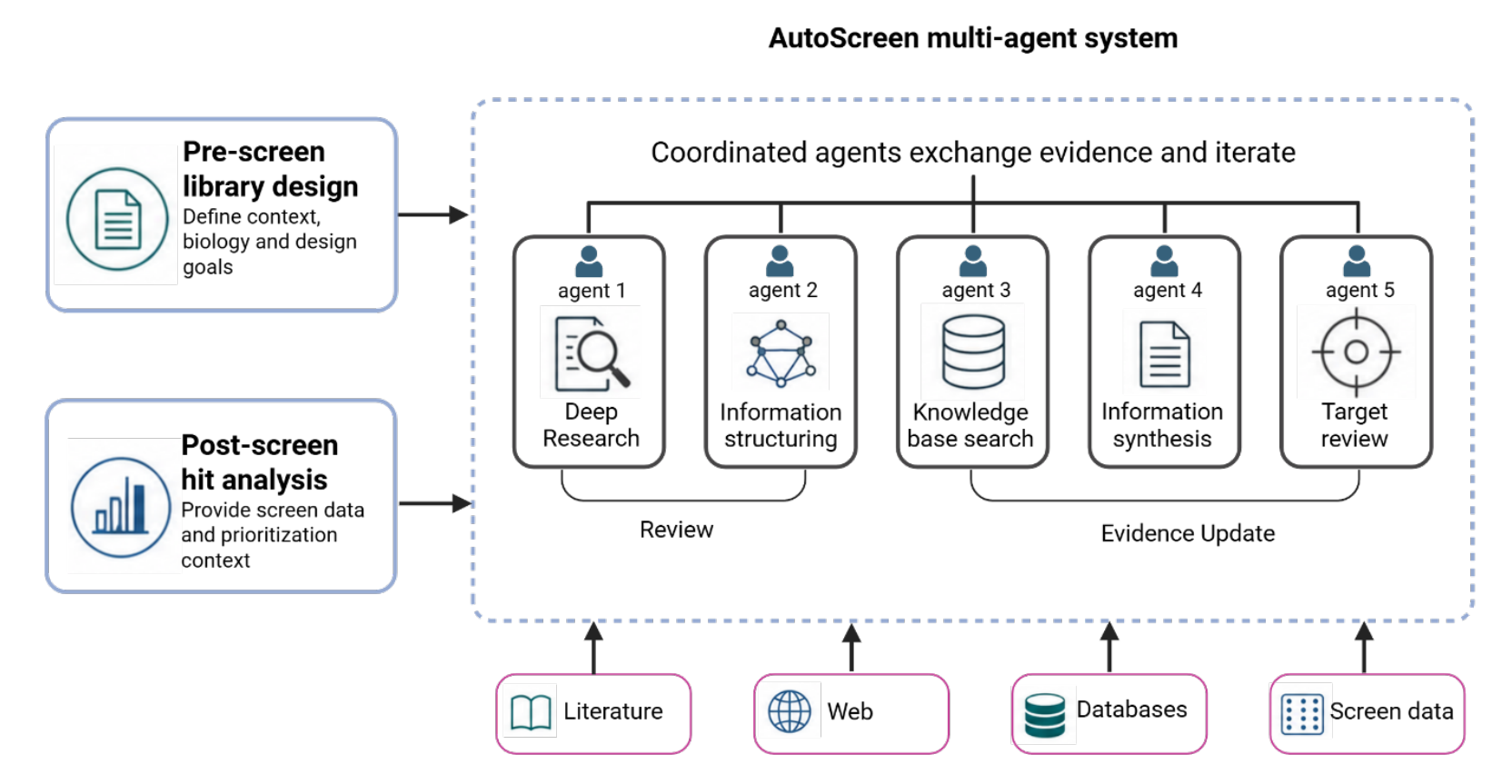
A recurring difficulty is that language models favor familiar genes. A well-known cancer gene may be a reasonable answer to a broad question but a poor choice for a particular cell type or experimental condition. AutoScreen generates a screen-specific list of familiar genes to avoid over-prioritizing, then uses that guidance to explore other candidates. It combines rankings from several versions of this guidance to reduce dependence on a single generated list.
Across 320 public genome-scale CRISPR screens, AutoScreen recovered approximately 19% more reference screen hits among its first 100 predictions than the strongest agent baseline. This retrospective benchmark measured agreement with the original screen results. The experimental studies examined whether the approach could also help prioritize genes with measurable biological effects.
Following up on cancer immune-evasion candidates
One application focused on human K562 leukemia cells exposed to primary human natural killer cells. The researchers used CRISPR activation to increase expression of cell-surface genes, then sequenced the cancer cells that survived immune attack.
The screen produced many candidates. AutoScreen used the experimental rankings alongside literature, pathway, and other biological evidence to help prioritize follow-up. MUC1 moved from rank 118 to rank 5, while PDPN and LRRC15 also moved higher in the ranking.
Researchers then tested the three genes individually. Using multiple guide RNAs for each gene, they activated MUC1, PDPN, or LRRC15 and repeated the NK-cell killing assay. Activation of all three increased the leukemia cells’ resistance to killing relative to non-targeting controls.
These results support using AutoScreen to choose biologically relevant genes from an existing screen for follow-up. The follow-up experiments confirmed that activating the genes AutoScreen prioritized made the cancer cells more resistant to NK-cell killing.
In a separate human melanoma screen, AutoScreen retained the strong CEACAM1 signal and raised the rankings of CEACAM5 and CEACAM6. As in the leukemia screen, evidence from outside the screen helped identify additional candidates worth a closer look.
Proposing targets before seeing the results
The team also evaluated AutoScreen’s ability to propose targets without receiving experimental screen results.
The tasks involved two mouse cancer models: melanoma cells challenged with PMEL T cells and colon cancer cells challenged with OT-I T cells. AutoScreen generated candidate gene lists from descriptions of the research goals. Those proposals were evaluated against newly generated CRISPR screens using a shared focused library.
Across the two screens, AutoScreen’s proposals recovered 77.1% of the consensus hits identified by two analysis methods, compared with 71.4% for the strongest general-purpose language-model baseline. AutoScreen had higher recovery in both settings.
This is an encouraging result from two experimental contexts. Further studies will establish how well the approach transfers to other biological questions and how reliably it prioritizes candidates beyond existing knowledge.
The project also includes the AutoScreen Resource Hub, which contains precomputed reports for public CRISPR, gene-expression, and genetic-association studies. Reusing this evidence can reduce repeated searches while allowing the system to generate rankings tailored to each new question.
What this suggests about AI-assisted discovery
AutoScreen explores how AI can help researchers work through a large body of biological evidence and decide which experiments to run. Researchers need to know why a target fits their question and what evidence supports it. Lab experiments then test whether the recommendation holds up.
Cancer immune evasion is one setting where better prioritization could be useful. Genes that alter sensitivity to NK or T-cell killing may inform future combination therapies or immune-cell engineering. Establishing a therapeutic opportunity, however, requires substantially more than a positive result in a cell-based assay.
The work also highlights a limitation of knowledge-based agents. Existing literature can help an agent recognize useful biology, but it can steer the system toward what is already known. Evaluating these systems requires distinguishing recovery of established findings from predictions made before experimental results are available.
AutoScreen gives agents a direct role in target discovery. The agents bring together biological evidence and propose targets, and researchers decide which candidates to test. The follow-up work in Le Cong’s lab confirmed that several of these targets affect cancer immune evasion. We want to extend this approach across biological questions and make agent-assisted target discovery a routine part of experimental research.