

Phylo x Biohub: ESMC-6B and ESMFold2 are integrated in Biomni Lab!
By Phylo
Biohub’s latest protein models are deployed on Biomni Lab. You can query them directly from the chat, no setup, no GPU provisioning, no model files to manage.
What’s available:
- ESMC-6B - a state-of-the-art protein language model, fully open for the first time. Use it for residue-level embeddings, zero-shot variant effect prediction, and any downstream task that benefits from a strong protein representation.
- ESMFold2 - single-sequence structure prediction. No MSA required. Built for accuracy on de novo and orphan proteins where MSA-based methods struggle.
- ESMFold2-Fast - a faster structure prediction path for lightweight screening, iteration, and exploratory folding directly from sequence.
Together, these give computational biology teams the core tools they reach for: protein representations, structure prediction, and a searchable universe of precomputed protein data. They join Biomni Lab’s growing model hub, where researchers can access a broader set of protein modeling tools and choose the right workflow for each scientific question.
Use Case #1: mapping ALS mutations onto a predicted PFN1 structure
To show what this looks like in practice, we ran a lightweight structure-interpretation workflow on PFN1, a human actin-binding protein linked to amyotrophic lateral sclerosis.
Fetch the human PFN1 (UniProt P07737) sequence and run ESMFold2-Fast from our HPC tools to predict its structure. Map the four known ALS disease mutations (C71G, M114T, E117G, G118V) onto the structure, report local pLDDT for each, and give a short interpretation of the predicted fold and whether the mutations cluster on the actin-binding face.From there, Biomni reports the local confidence around each mutated residue, summarizes the predicted fold, and asks whether the variants cluster near the actin-binding face.
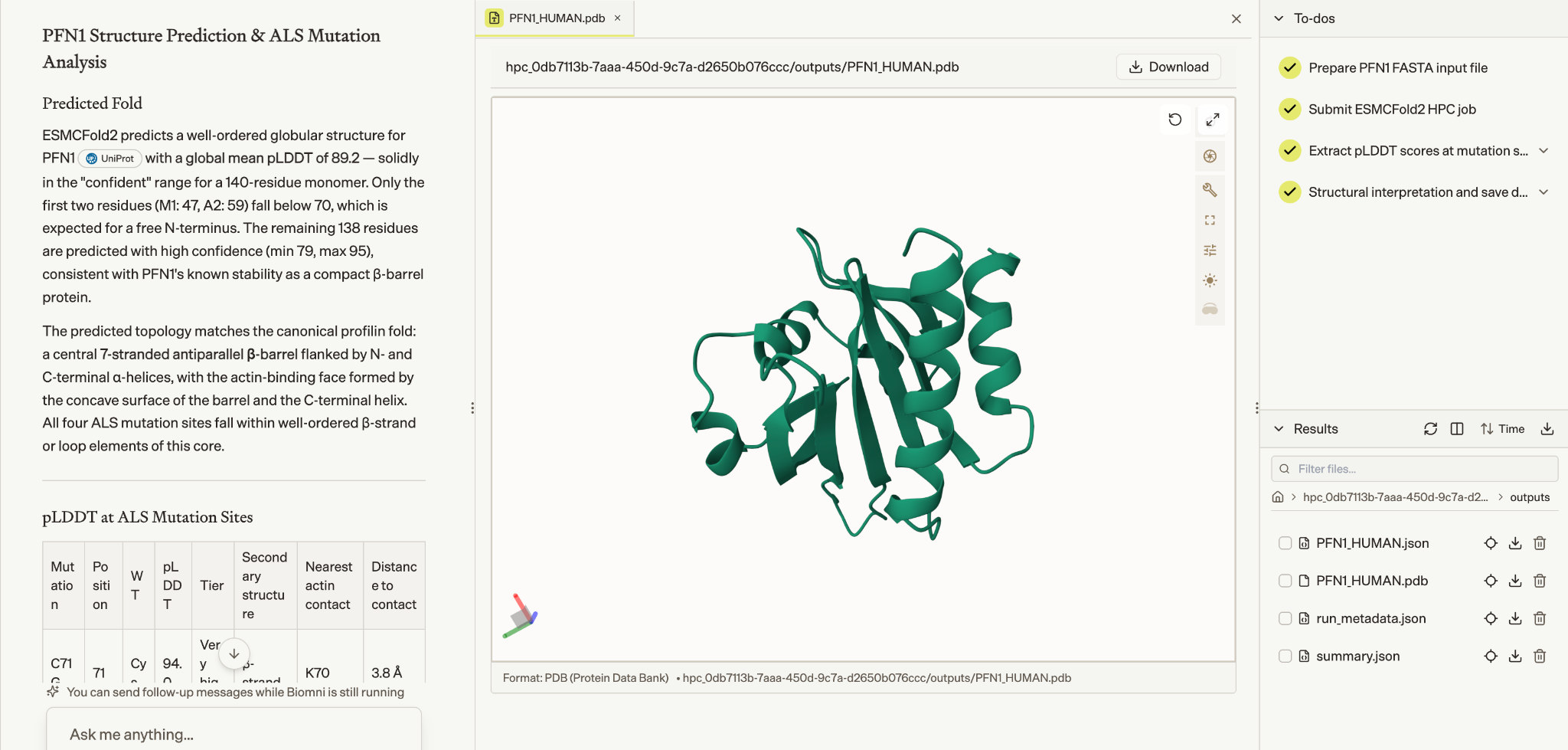
PFN1 structure prediction with ALS-associated mutations mapped onto the predicted fold, showing pLDDT confidence scores for each variant site.
Use Case #2: prioritizing SOD1 variants of uncertain significance with ESMC-6B
To demonstrate ESMC-6B, we ran a zero-shot variant prioritization workflow on SOD1, a canonical ALS-associated protein.
Pull the first 15 ClinVar missense variants of uncertain significance in SOD1, run ESMC-6B on the canonical UniProt sequence, and rank each substitution by log-likelihood ratio. Cross-reference the ranked variants with known ALS hotspots, metal-binding residues, dimer-interface positions, and key structural loops.Biomni returns a ranked table of reclassification candidates with ESMC score, position, nearest ALS hotspot, and structural context. In this run, D97E and T136I showed the strongest ESMC disruption signals, while I113S and C7Y stood out structurally because of their relationship to known ALS-associated positions and the SOD1 dimer interface.
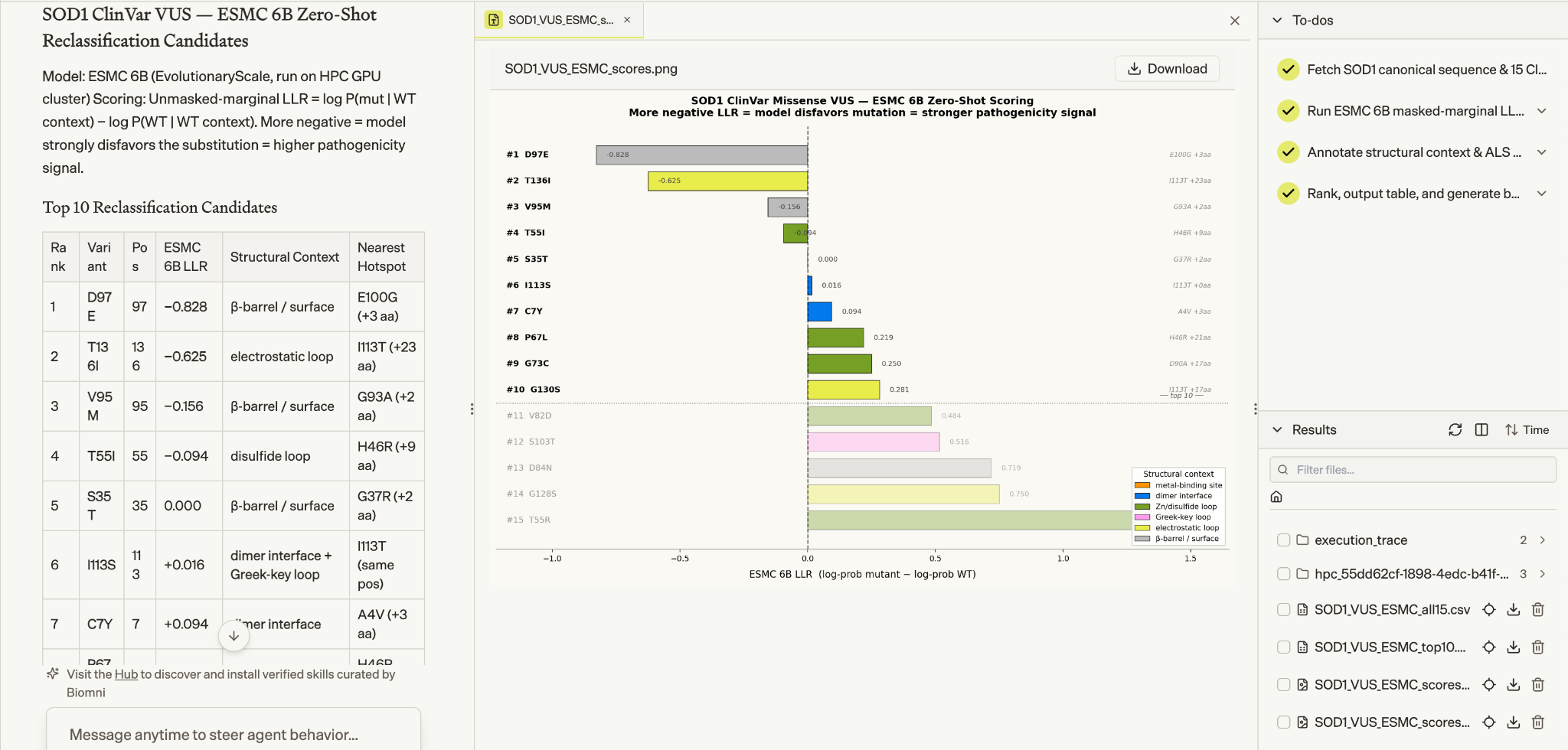
ESMC-6B zero-shot variant effect scores for SOD1 ClinVar VUS, ranked by log-likelihood ratio with structural context annotations.
Try it now
Start using ESMC-6B, ESMFold2, and ESMFold2-Fast on Biomni Lab’s HPC cluster today.