

Building state-of-the-art biology AI models autonomously
By Phylo
We present Biomni x TusoAI, a fully autonomous and code-free tool for method development in biology — building state-of-the-art models for genetic perturbation prediction and enhancer-gene linking from a single sentence of natural language.
Computational methods are needed across all fields of biology and are central to discovery, but their slow development leads to a vast amount of experimental data remaining underutilized and poorly understood. Just as the lowering cost of sequencing has made biology increasingly measurable, a scalable approach to method development is needed to make these measurements interpretable.
Agentic methods like Autoresearch or AlphaEvolve have begun to automate scientific and ML code improvement. A key barrier to the widespread adoption of these tools is their usability. These are often closed-source or expensive — costing hundreds of dollars to run, and require a huge amount of setup for compute infrastructure, code, data, text, and parameter input to achieve optimal performance. Biology also presents unique challenges to method development, dealing with massive code repositories and simultaneous search over not only useful code but also useful data to solve a problem.
To effectively automate method development in biology, we present Biomni x TusoAI, a fully autonomous and code-free tool for method development. We have been expanding upon our agentic tool for method development TusoAI (previously published at ICLR) to cater it to the specific challenges of biology. TusoAI coordinates agents to efficiently and autonomously evolve entire codebases thousands of times without human oversight, returning a higher performing version with new algorithmic and data innovations. TusoAI mimics a real computational biologist by mining literature and iteratively implementing, debugging, and evaluating improvements, while favoring simpler methods and retaining memory across iterations, powered by a custom-built agent harness. Here, Biomni can both automatically set up and run TusoAI itself given an API key, or emulate TusoAI’s method development cycle itself — no API key needed.
We highlight several advantages of Biomni x TusoAI:
- Searches over data and code simultaneously and autonomously
- Iterates hundreds of times per dollar spent
- Guaranteed to produce efficient-methods
- Requires no environment configuration, data setup, or coding whatsoever
Methods can now be developed entirely in one sentence of natural language. This is the most accessible method development has ever been in biology.
Below, we show Biomni x TusoAI developing new powerful models for (1) enhancer-gene linking and (2) genetic perturbation prediction. This work will be published in the coming months, and the new TusoAI is available early and open-source at github.com/Alistair-Turcan/TusoAI. Access to Biomni x TusoAI is available today at biomni.phylo.bio under the skills tab.
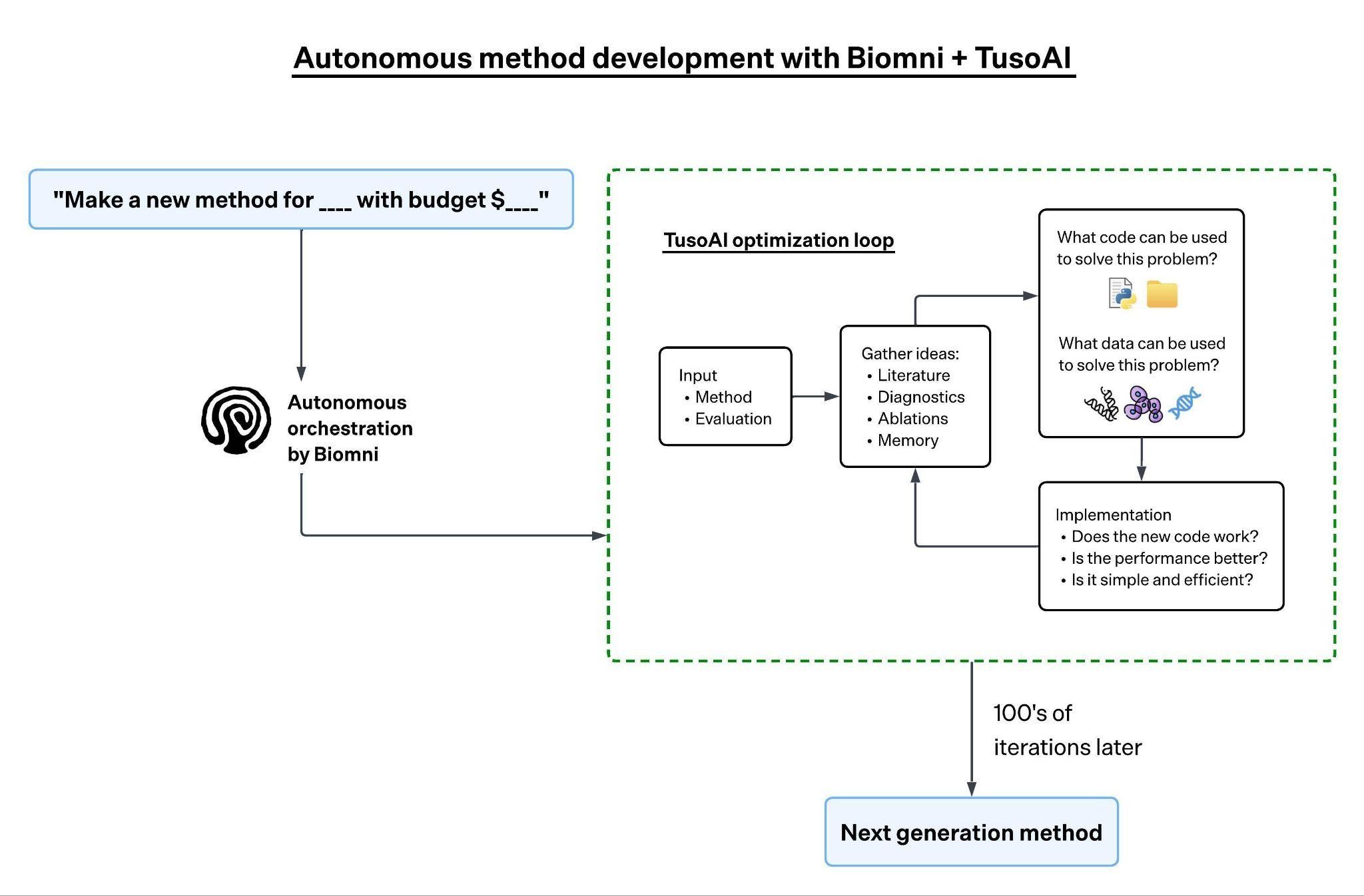
Figure 1: Using Biomni to orchestrate TusoAI.
Applications of Biomni x TusoAI
1. State-of-the-art genetic perturbation prediction
Predicting the transcriptomic effects of CRISPR gene knockouts is a promising but difficult task with sizeable interest, including the annual Virtual Cell Challenge with hundreds of groups participating. This task is challenging because the setup is unclear, evaluations disagree, and the proper data to use is unknown.
We apply Biomni x TusoAI to 3 independent benchmarks to build a new perturbation prediction method from scratch. Biomni searches over gene embeddings, training and evaluation strategies, and the models to link all these together, improving performance on a small validation subset of the data. After 1 week of iterating autonomously and testing 500 candidates, Biomni x TusoAI discovers a new method integrating 9 sources of gene embeddings with an ensemble of simple regression and kNNs that outperforms every method, including massive deep learning models, on almost every metric and dataset.
While perhaps surprising, this simpler method makes perfect sense in the literature. Previous work had identified that richer gene embeddings lead to stronger performance, but had not carefully tuned each individual data source, but instead applied the same embedding procedure to dozens of data sources. Here, Biomni x TusoAI took this paradigm further, discovering customized gene embedding strategies that enabled simple models to learn perturbational effects. This new method is available publicly at github.com/phylobio/TusoPerturb.
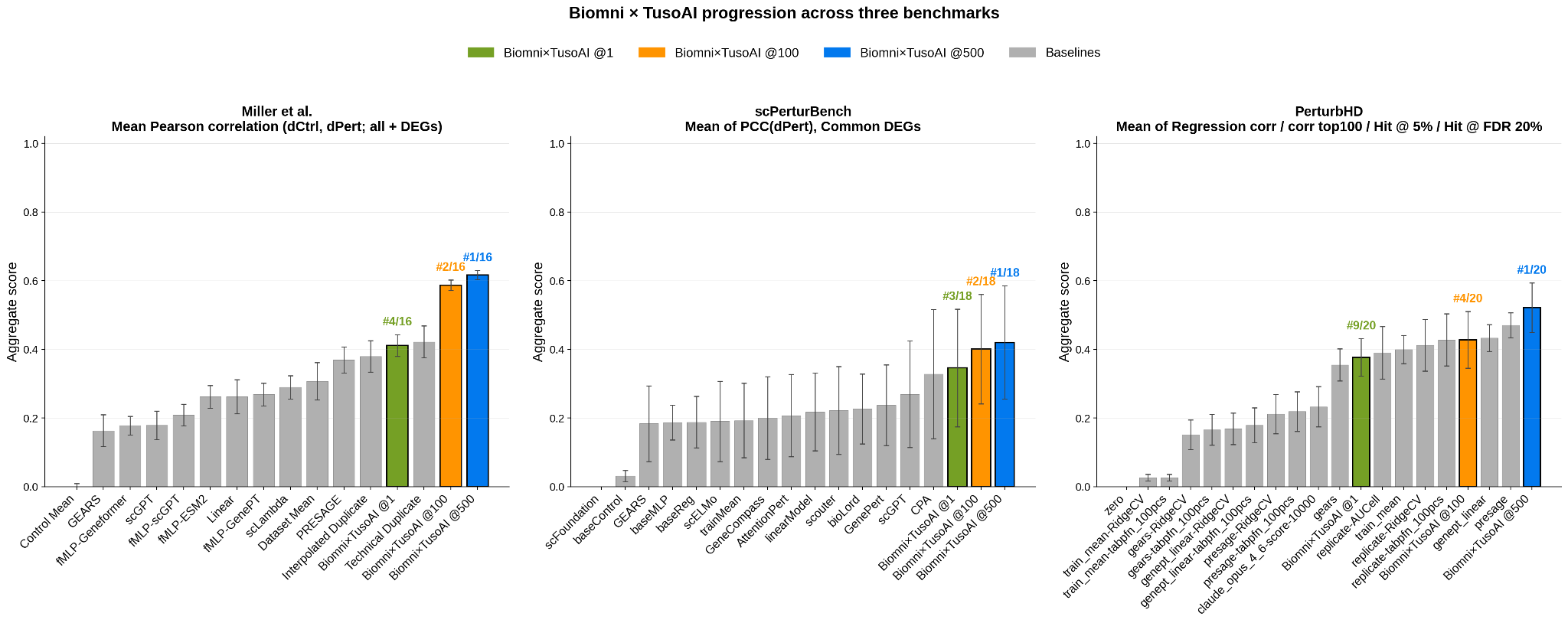
Figure 2: Performance of a new genetic perturbation model built by Biomni x TusoAI.
2. Discovering novel features for enhancer-gene linking
The identification of enhancer-gene links has become a central task in human genetics, pursued by several large efforts including the ENCODE Consortium. State-of-the-art methods follow a familiar paradigm — gathering large amounts of data from DNA sequences, epigenomic tracks, Hi-C contacts, multiome data, and more, then manually building some set of features from this data that are useful for linking enhancers to genes.
To automate the development of enhancer-gene linking methods, we applied TusoAI to build and test thousands of features from a large corpus of data. Starting from a leading method pgBoost and 36 different genomic data sources, TusoAI iteratively builds and tests features from these data to improve upon pgBoost. After 10,000 iterations, TusoAI built a new model, integrating an additional 23 novel features from 14 different data sources. This new model substantially outperformed all methods on ground truth eQTL evaluations, including a 5-fold improvement at difficult distal (>100KB) links. Similar strong performance was observed for ground truth CRISPR and GWAS evaluations.
The two most important new features are heavily engineered versions of the common paradigm of using the SNP-TSS distance. Instead of naively inputting SNP-TSS distance, these two redesign this as strand and gene overlap-aware sigmoid-transformed covariates. Other features are completely novel to pgBoost, including binary intron flags, GC content surrounding the SNP, and engineered ABC scores.
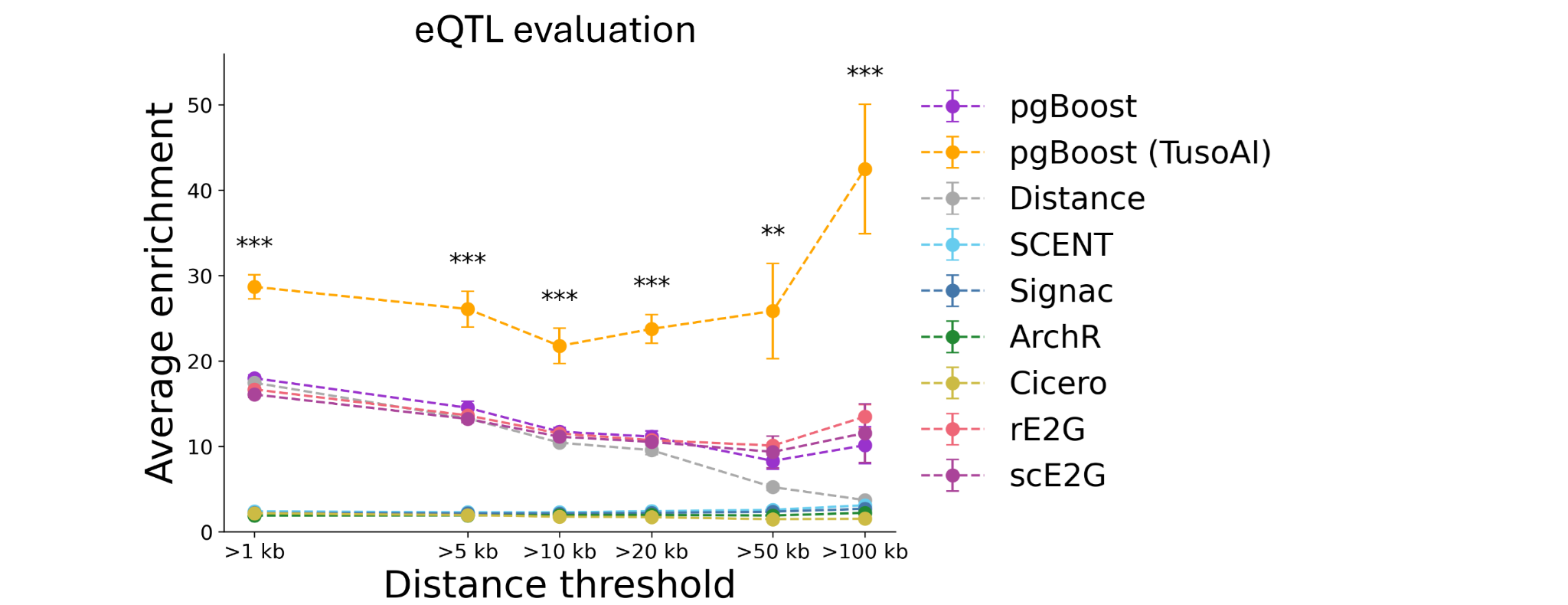
Figure 3: Improving enhancer-gene linking with TusoAI. Average enrichment of ground truth eQTLs across various distance thresholds. pgBoost (TusoAI) denotes the TusoAI-improved version of pgBoost.
Try it today at biomni.phylo.bio by prompting with your favorite task. Biomni-Tuso is now available as an auto-research skill in Biomni Lab for enterprise users; for public platform, we will share 500 GPU hours for 100 Biomni lab users as we prepare to roll out this capability broadly. Apply here.