

Target Atlas: One Evidence Layer Across Diseases
By Gregory Minevich, Founding Member of Technical Staff
Target Atlas is Phylo's target-prioritization app on Biomni Lab, launching with thousands of target–disease assessments and a dedicated Parkinson's disease edition developed with The Michael J. Fox Foundation's Targets to Therapies initiative.
Target Atlas is Phylo's target-prioritization app, running on Biomni Lab, Phylo's Integrated Biology Environment. The general Atlas launches with thousands of target–disease assessments curated by hundreds of agents. Launching alongside it is a dedicated Parkinson's disease edition developed in collaboration with The Michael J. Fox Foundation for Parkinson's Research (MJFF).
The most expensive decision in drug discovery is made with the least evidence
Some evidence measurably improves the odds of clinical trial success: across 13,022 target–indication pairs, drug mechanisms with human genetic support had an estimated 2.6-fold higher probability of success from Phase 1 to approval (Minikel et al., Nature, 2024). But genetics is one input among many — expression, safety, tractability, biomarkers, and competition all sit beside it — and assembling a current, auditable view of all of them across thousands of targets and diseases takes more time than a manual process can sustain. Target Atlas is built to do that assembly continuously for target prioritization and target review.
Inside Target Atlas
Target Atlas helps researchers explore and compare potential drug targets. Automated workflows and computational skills gather and organize the evidence, then rank targets across the categories that matter for each disease. Researchers can chat with existing profiles, add new evidence categories, and upload their own data to see how profiles and rankings change.
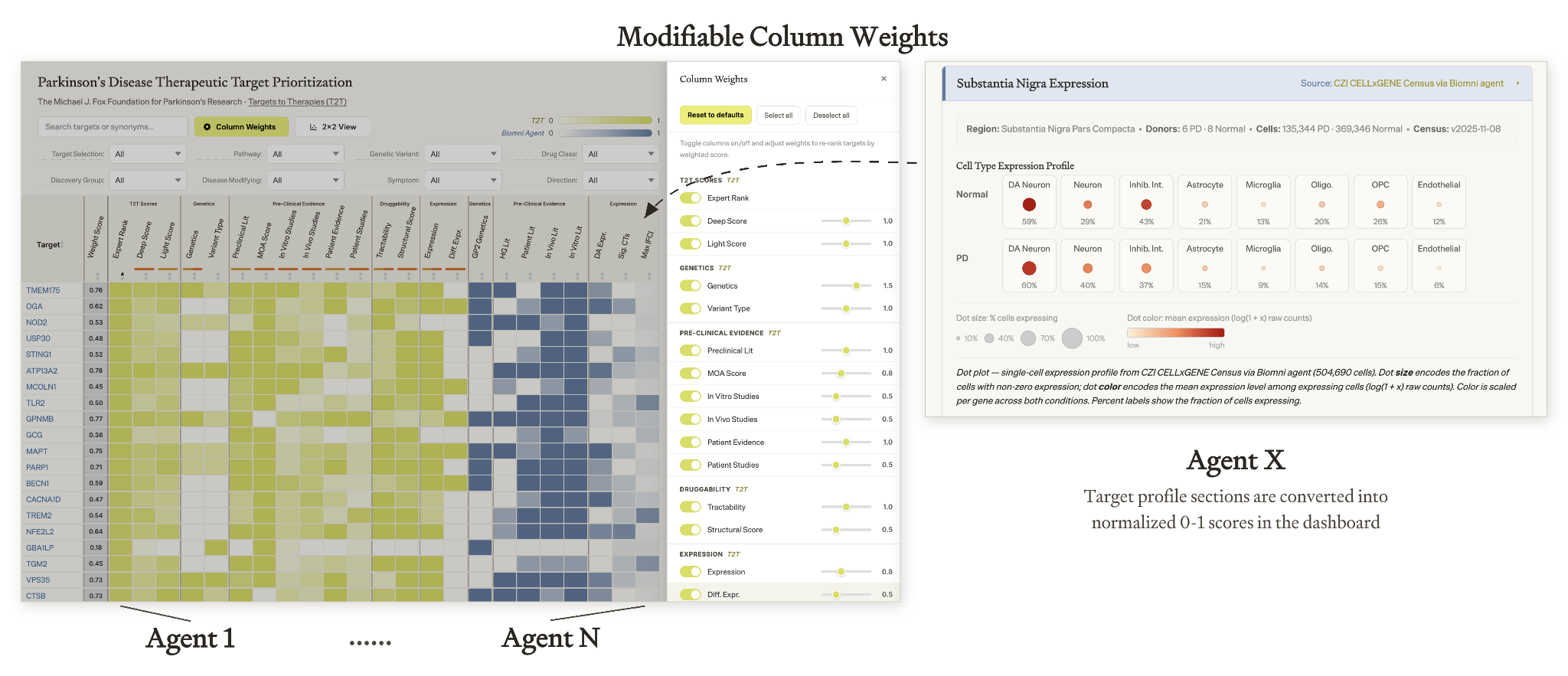
A versioned computational agent produces both dashboard fields for cross-target comparison and a source-linked target-profile section with the supporting analysis. In this example, the same scRNA-seq cell-type expression analysis is shown in detail on each target profile and summarized as a normalized dashboard score for cross-target comparison. The dashboard score is a weighted average of those normalized columns, so changing any weight immediately re-ranks the cohort.
Target profile pages
Each target–disease assessment opens into a profile covering genetics, patient evidence, expression, clinical activity, safety, tractability, competition, and therapeutic hypotheses, each section with its own citations and time stamps.
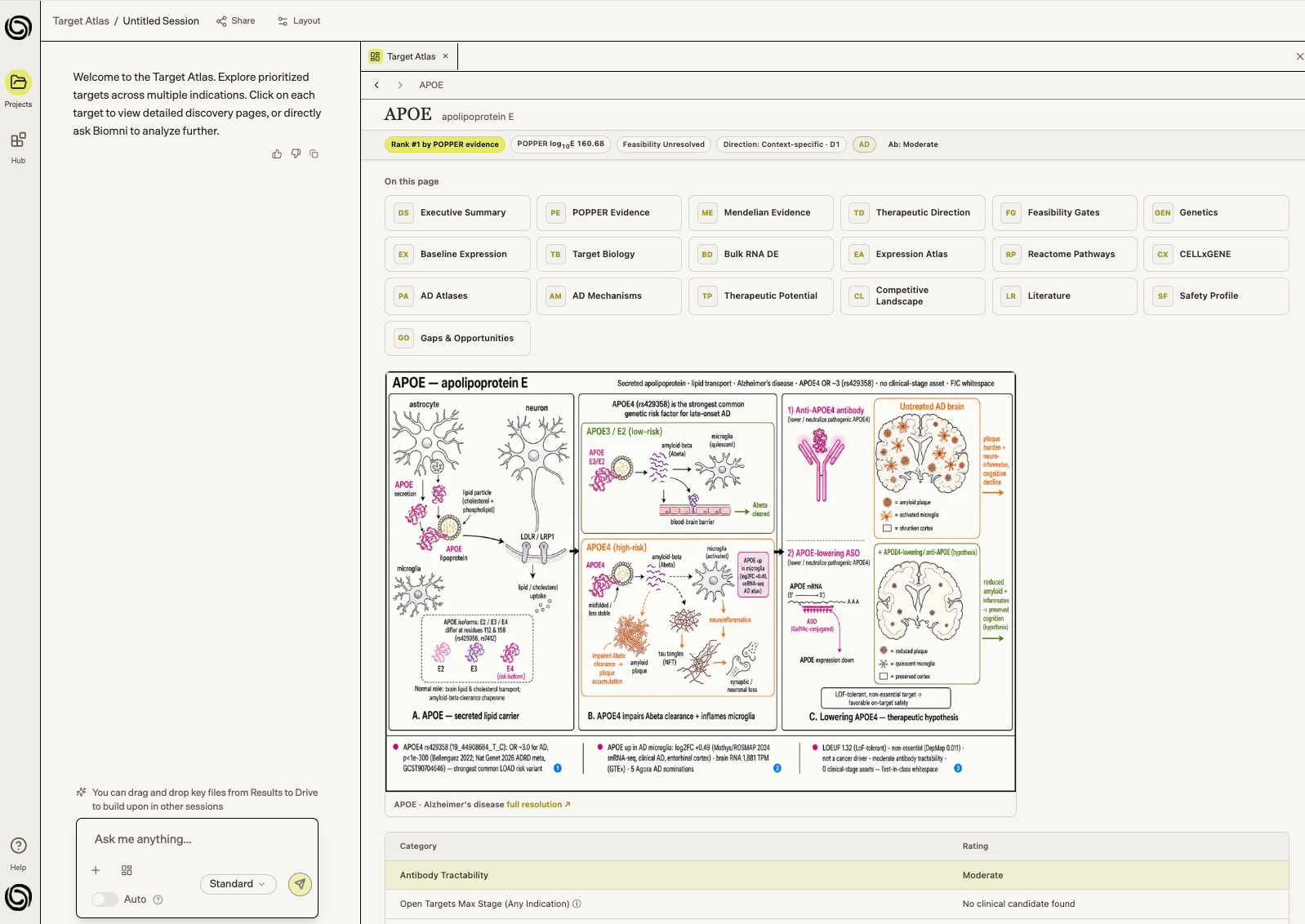
The APOE profile in Alzheimer’s brings rank, source-linked evidence, and a mechanism summary into one view.
Three example agents behind a profile section:
- Single-cell analysis computed from source data. For diseases with a pinned CELLxGENE dataset, the workflow runs donor-aware differential expression from raw counts and labels non-significant results explicitly.
- Full-text literature review. Reviews organize evidence across human genetics, patient samples, in vivo studies, and in vitro studies.
- Competitor programs confirmed to act on the target. Each trial is reviewed drug-by-drug, separating real competition from symbol collisions or biomarker arms.
Review agents also audit the content behind every profile — checking cited studies and trials against their source records, correcting misstated findings, and flagging anything that isn't direct evidence for the target in that disease. Errors can still slip through, so we welcome feedback from the community: if something looks wrong, please let us know at support@phylo.bio.
Interactive 2×2 plots
A ranked table orders targets but can hide tradeoffs between criteria. Any two evidence fields can be plotted against each other, with cohort-median guides on continuous axes; targets missing either value are omitted rather than scored zero.
Click a point to inspect the values behind its position, then continue into the full profile. Comparing expert rank with dopaminergic-neuron expression in the MJFF Parkinson's edition, for example, shows where expert and molecular evidence converge — or where a candidate warrants a closer look.
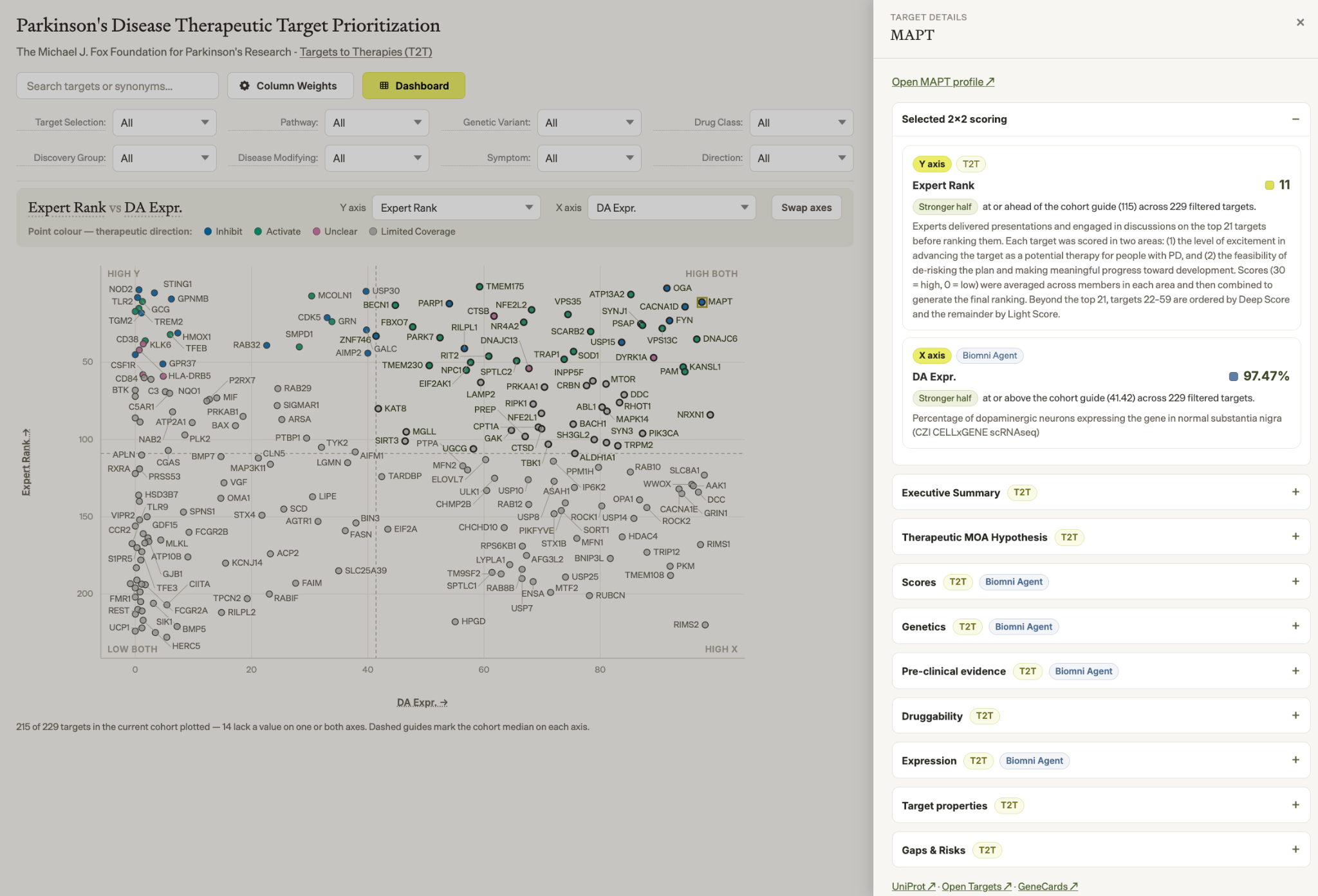
Expert rank vs. dopaminergic-neuron expression across the full candidate cohort: of 229 targets, 215 have values on both axes. Selecting MAPT opens the scoring and source details behind its position.
The MJFF Targets to Therapies (T2T) Parkinson's edition
Among the available disease dashboards in Target Atlas is the MJFF Targets to Therapies (T2T) dashboard. MJFF’s T2T initiative used community nominations, expert review, evidence scorecards, and a published method to prioritize Parkinson’s disease targets. Over nine months, it narrowed 229 candidates to 59 for deeper review (Vaiana et al., npj Parkinson’s Disease, 2025).
This public, interactive T2T Parkinson’s dashboard builds on T2T’s expert-curated information with additional analyses linked to supporting evidence. Researchers can compare targets, investigate questions relevant to their work, and upload and analyze their own data alongside existing evidence to see how it strengthens, challenges, or expands a target profile.
The T2T Parkinson’s dashboard makes target profiles and rankings easier to explore, update, and expand while retaining their expert-curated foundation. Researchers and scientific experts remain essential for identifying important questions, assessing evidence, interpreting results, and validating findings. Target Atlas supports their judgment by making the underlying evidence more accessible.
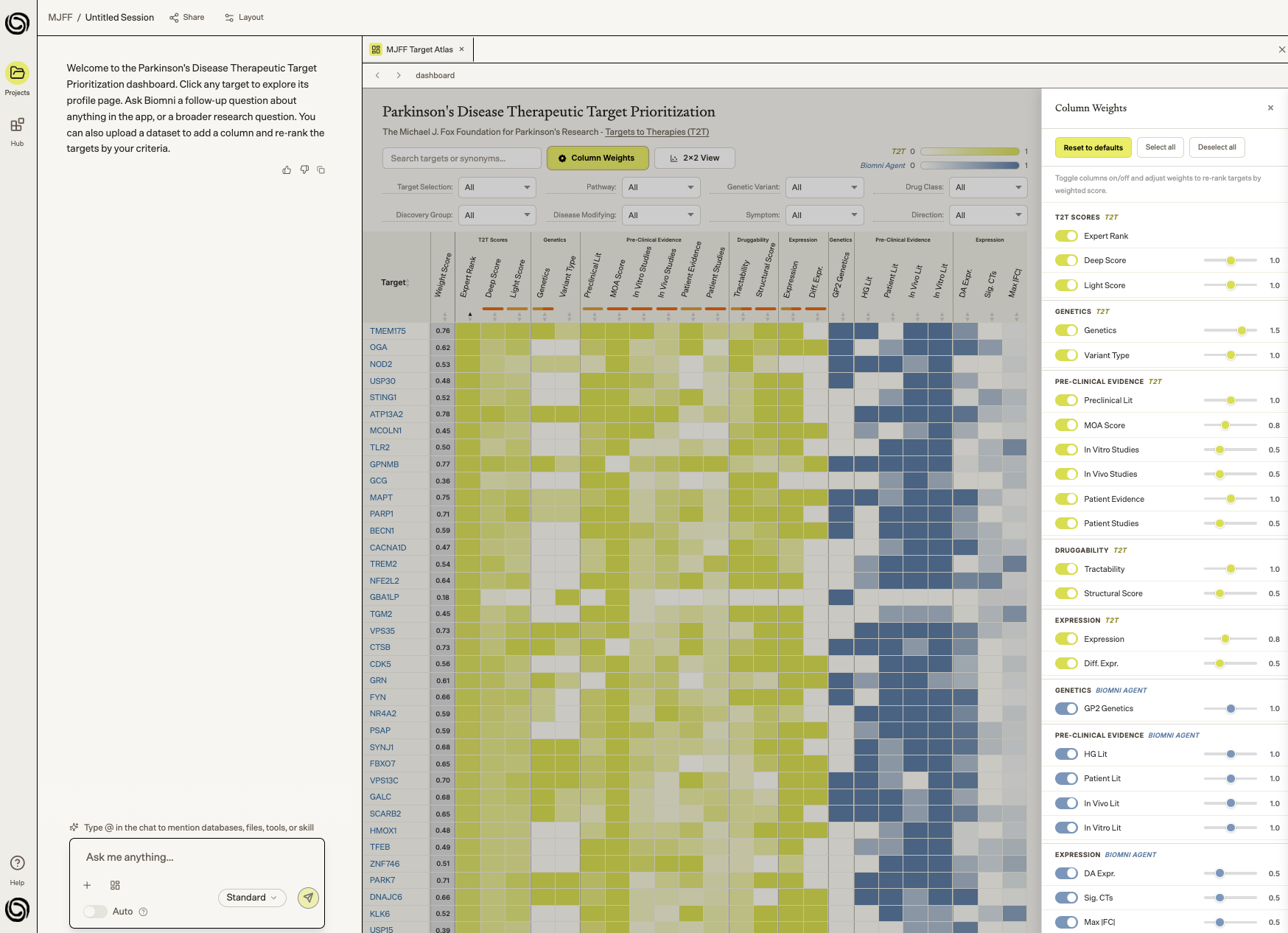
The MJFF Parkinson's dashboard keeps all 229 T2T candidates explorable, with filters for the Top 59 and Top 21 tiers and source-linked evidence alongside MJFF's framework.
Public Edition of Target Atlas
Free with a Biomni account, the public edition of Target Atlas includes:
- The T2T Parkinson’s dashboard from The Michael J. Fox Foundation for Parkinson’s Research is open to everyone. All data, evidence, and features are freely available to researchers and the wider community.
- Thousands of target-disease assessments and a growing cross-disease public atlas, with a roadmap to cover all major diseases over time.
- Selected, evidence-supported target cohorts: a target is included once it clears at least one stated evidence channel: human genetics, disease-relevant differential expression, clinical activity in the disease, a curated clinical biomarker, or literature nomination.
- Standard dashboards, target profiles, and 2x2 plots including evidence gaps and analytical opportunities.
- Private extensions for Biomni users. Add evidence criteria and profile sections to a personal view without changing the shared public Atlas.
Enterprise Edition of Target Atlas
An enterprise beta version is available through an annual license for a single-tenant Biomni deployment, with usage on Biomni's credit-based model. It includes:
- All 20,000-plus targets per selected disease. Assess the full target universe, including evidence-sparse and previously un-nominated targets.
- Your data, integrated. Combine proprietary screens and internal omics, raw or processed, with the public evidence layer.
- AI/ML-based target scoring. Train and validate models that prioritize targets and estimate disease-specific evidence weights alongside expert-set weights.
- Target-pair dashboards. Evaluate bispecific and dual-target CAR-T strategies using measured co-expression, AND/OR logic, per-antigen safety, and clinical precedent.
Explore, Deploy, or Sponsor a Disease
The T2T Parkinson’s edition offers one example of how an expert-curated prioritization framework can be paired with a continuously updateable evidence layer. The community's judgment remains central, while evidence assembly, refresh, and expansion can continue without rebuilding the process from scratch.
Phylo is seeking foundations, consortia, and patient organizations to sponsor additional disease editions that can be published free to their research communities, with the organization's prioritization framework represented in the scoring layer.
- Scientists and target-discovery teams: explore Target Atlas on Biomni and open the disease relevant to your work, including the MJFF Parkinson's edition.
- R&D leaders: request an Enterprise demonstration using your disease, targets, and internal decision criteria.
- Foundations and consortia: discuss sponsoring a disease for your research community.
Acknowledgements
Special thanks to our partners at The Michael J. Fox Foundation’s Targets to Therapies initiative: Gaia Skibinski, Grace Navarro, Dave Alonso
Phylo team: Kexin Huang, Serena Zhang, Noah Lebovic, Margaret Hua, Yeyang Zhang